Wednesday, April 23, 2008
Look3: Festival of the Photograph 2008
Phew! After sitting on the Tapes that Bryan Harvey and I shot at last year's festival for almost a year, I got the rushed call to put together a promo piece, and here it is. Lots of folks helped tighten, and having just taken a FCP class I've had the opportunity to learn everything I could have done more efficiently ;-)
Also had much fun working with my friend Addison Brady on the music and mix for this - the feedback so far has been positive, and we had a lot of fun doing it (also looks like a cut-down will be airing on WVPT next week). If you're coming to Charlottesville in June, be sure to drop me a line!


Sunday, March 16, 2008
Wednesday, March 12, 2008
Friday, February 29, 2008
Opportunity Knocks

It's usually the case that the busier I am, the less time I have to write about the work. I'm taking a breather this weekend to add OK Radio to the show roster on this blog, as I've been working with Host/Producers Joe Folan and Lynne Norton for several months to put the pieces together for this new series.
I can't describe it better than they do, so I'm just going to steal the description directly from their website:
Welcome to OK Radio, podcasts designed to provide real world insight and context from leaders and experts in the nonprofit community.
Opportunity Knock’s mission is to bring nonprofit professionals and organizations together. Through OK Radio’s interviews we not only provide valuable information on everything from career matters to sector trends, but also learn some fun facts about the thought leaders that are featured.
Pretty cool, no?
I've worked with Joe in the past and really appreciate the work he and Lynne were willing to do even prior to the first interview to get the right strategy and voice together for this podcast. It's a good listen no matter what line of work you're in, so enjoy the show!
Friday, December 28, 2007
Call Recording with Rondee
The recording feature is in beta, but phone recording is perhaps one of the easiest ways to acquire audio for your podcast and this new company has a free service (you'll pay a toll charge to dial in to the 619 area code at the moment) for connecting conference callers, which would work great for distance interviews or simply simplifying your podcast recording.
Rondee CEO Andre Vanier talks to Robert Scoble in his latest, and typically (occasionally painfully) unedited/raw vids for PodTech. Note to Robert: if you're going to spend all that time on the graphics, would a few edits kill you?
Rondee CEO Andre Vanier talks to Robert Scoble in his latest, and typically (occasionally painfully) unedited/raw vids for PodTech. Note to Robert: if you're going to spend all that time on the graphics, would a few edits kill you?
Wednesday, November 28, 2007
Bethlehem Steel
A few images (pulled from video in my room at the historic Hotel Bethlehem, pardon the resolution) from this week's doc shoot at Bethlehem Steel, perhaps one of the most amazing feats of human engineering I've ever experienced. It's not every day you get to wear a hard-hat to work; thanks Charlie! (and thanks to the Smiththsonian's National Museum of Industrial History for the tour).


Monday, November 19, 2007

Monday, November 12, 2007
Converting files using iTunes
Sending audio files can be a cumbersome task. I edit a lot of dialog that’s delivered via FTP, YouSendIt, etc., and have found the following process can make the task a bit easier on the uploader. In this "lesson", we'll take a fairly cumbersome WAV file, and convert it to a more manageable MP3 file that retains most of the quality of the original, using iTunes:
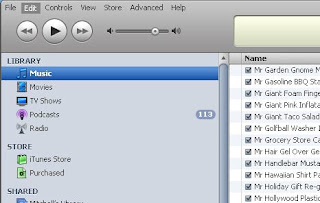
1. Open iTunes, then from the top Menu select Edit, then Preferences… (the keyboard shortcut for Apple is Command + “,”, for PC it’s CTRL + “,”)
Click the “Advanced” Tab, and then select the “Importing” Tab in the menus below the top row of tab options.
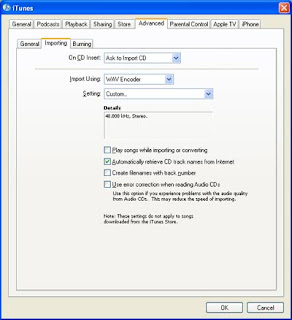
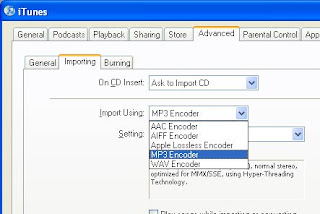
The second option in this menu is “Import Using:” – from the drop-down menu, select “MP3 Encoder”:
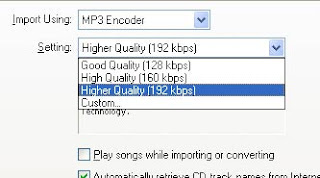
Immediately below, select a “Setting” option. For dialog, I recommend “Higher Quality (192 kbps)”:
Click OK at the bottom to save these settings.
Now, iTunes knows what to do, but we’ll also have to tell it WHERE to do it.
Import your file to iTunes; the easiest way to do this is to find the file and drag it into the iTunes interface. Depending on your settings, this will either
Make a copy of the file or add it to the iTunes index. Either way, this isn’t too important for today’s lesson.
OK, now your file is in iTunes:

Right-click the file (command-click on a Mac) and from the menu select “Convert Selection to MP3”. Once you click, the operation begins…
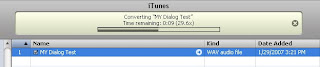
And when the operation is finished, you end up with a copy of the original file, with much smaller file size. The quality is only slightly diminished and for most dialog work, wouldn’t be noticed at all!
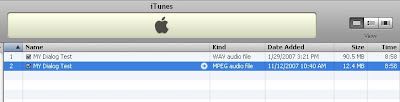
(Still having problems finding the file to FTP, email or YouSendIt? Just right –click the new MP3 and select “Show in Windows Explorer”).
1. Open iTunes, then from the top Menu select Edit, then Preferences… (the keyboard shortcut for Apple is Command + “,”, for PC it’s CTRL + “,”)

Click the “Advanced” Tab, and then select the “Importing” Tab in the menus below the top row of tab options.

The second option in this menu is “Import Using:” – from the drop-down menu, select “MP3 Encoder”:

Immediately below, select a “Setting” option. For dialog, I recommend “Higher Quality (192 kbps)”:

Click OK at the bottom to save these settings.
Now, iTunes knows what to do, but we’ll also have to tell it WHERE to do it.
Import your file to iTunes; the easiest way to do this is to find the file and drag it into the iTunes interface. Depending on your settings, this will either
Make a copy of the file or add it to the iTunes index. Either way, this isn’t too important for today’s lesson.
OK, now your file is in iTunes:

Right-click the file (command-click on a Mac) and from the menu select “Convert Selection to MP3”. Once you click, the operation begins…

And when the operation is finished, you end up with a copy of the original file, with much smaller file size. The quality is only slightly diminished and for most dialog work, wouldn’t be noticed at all!

(Still having problems finding the file to FTP, email or YouSendIt? Just right –click the new MP3 and select “Show in Windows Explorer”).
Thursday, November 08, 2007
Embassy Kitchens
From the archives: I had the fun pleasure of working as production manager on this pilot that, in truth, never went anywhere. Found this vid as I was cleaning off an old drive last night and thought I should put it somewhere I can't lose it (again). Aside from getting to meet Jeanne Moreau and Mayor Williams, the real highlight was spending the full day at the Ambassador's Residence in the company of their wonderful staff, and the special lunch the kitchen prepared for the crew. Best Craft Services - Ever. My favorite line, of course, is "This carpet drink the most vodka in the world!"
So why didn't it go anywhere? Mostly because you wouldn't believe how hard it can be to get clearance to film in an embassy, even in the kitchen. Shooting the pilot (for a French producer)was a cinch - getting other locations? Not so easy.
Monday, October 29, 2007
Hoos TV
I haven't placed much of my broadcast work on this blog. This summer I had the opportunity to co-direct (with UVA's Rob Smith) a few new image spots for The University. If you're watching any UVA Football or Basketball this year, you'll be seeing these.
Go Hoos!
UVA Faculty:
UVA Students:
Go Hoos!
UVA Faculty:
UVA Students:
Wednesday, October 24, 2007
Riding the HughTrain

I ran way behind on work yesterday as I had the good luck/bad luck of having a trip canceled last minute - but I was able to sneak in to the Online Marketing Update @ Darden and meet both Rick Klau of Google (né Feedburner), and Hugh MacLeod of GapingVoid.com. Special for me as I had the good fortune to work with Feedburner prior to the Google acquisition, and Hugh's blog is a daily read of mine. Both gave great talks, and Rick's overview of RSS - in a sophisticated, "what it means to your brand" context, dovetailed quite elegantly with Hugh's discussion of the Social Object in the context of marketing and, more importantly, customer relationships.
First point observed: being a cartoonist really spices up your PowerPoint.
Second point observed: don't assume that your audience understands RSS, and don't go too deep in attempting to explain the technology. When necessary, set aside four minutes to show your audience the wonderfully simple video, RSS in Plain English.
Next point (from both speakers) is the importance and benefit of being engaged in the conversation with your customers. This resonated with me, and the work we’ve been doing with PodSquad, because I grew up watching my father foster first-name relationships with his customers in his retail clothing stores; Rick realizes (and demonstrated) the value in continuing this practice in the online medium, and Hugh detailed the successes his clients and partners have experienced doing the same.
Hugh abstracted the concept of the "Social Object", which he explains, in my opinion, as clearly as can be done. Where Hugh is gaining traction in this theory is in the thesis of his talk: "Web 2.0 was invented circa 1917 in the South Pacific". His point isn’t 1917 – it’s that this is when modern anthropologists began documenting the importance of interpersonal relationships. In the marketing world, it boils down to very personal commercial interactions – in other words, every relationship is personal.
So this takes me to the next step and, likely, what will be the next entry here: how, exactly, does podcasting play into all of this? Not to mention another question was raised in one of our sessions: what makes a good podcast? I think they are one and the same: I/we were optimistic at the outset of this endeavor that this medium (the social web), and the podcast audience, represent an opportunity to return marketing communications (especially of a multimedia nature, which is simply our specialty) to the honest conversation of the most primitive commercial interactions. It gives both parties a chance to learn and to do better, and to participate in a Virtuous Circle of growth.
We still haven't asnwered the question that applies to PodSquad though: What makes a good podcast? I have some thoughts on that and would be happy to include yours.
Tuesday, September 11, 2007
It's on: Innovation Challenge 2007

Chic Thompson was in the studio to shoot this video invitation to the 2007 Innovation Challenge, final rounds to be held at Darden in November of 2007. I had covered this event doc-style last year and was looking forward to doing some fun (and useful) work with that footage in anticipation of the upcoming event. Some of that work appears here, but more of it (with context) will be coming out soon in a series of video podcasts we put together to help teams sharpen their skills in brainstorming and presentation.
What was fun about this piece was the idea I stole for the backdrop. Yep, I said it, and freely admit, that this was an instance of Picasso's axiom "Good artists copy. Great artists steal." I've been watching a lot of Sundance Channel's "The Green" and loved these talking head shots:


The wide, "behind the scenes" shot used in the same piece revealed that this wasn't a chroma setup, but simply a projector sitting on the floor hitting a white paper background. Since we had zero time for post on our Innovation Challenge piece, we had to pull off everything in-camera and this seemed a great way to do it.
This idea, thanks to the fact that we had a great PhotoShop artist on staff at the time, took just an hour or so to set up (with appropriate time given to tweak the lighting for the talent) and I couldn't be more pleased with the result. The funny thing is, if this had been suggested to me verbally, I would have dismissed the idea immediately - a way of thinking I try to avoid, but we all have our personal traps, especially when it comes to creative. Anyway, in the upcoming Video Podcasts you'll learn how to avoid that trap, and many others.
Victoria's background plate, for the record, was this:

And again, for comparison:

It's amazing how the background shifted blue in the shot - but it was another fortunate, "just go with it" thing - the kind of thing it helps to stay open to!
Monday, August 27, 2007
The Panic of 1907

Shot in the Studio at Darden, we went for the "Movie Junket" look - a decision arrived at as soon as the poster arrived ;-)It was a real treat to read a book over the weekend and then have the opportunity to sit and pick the author's brain on-camera.
(by the way, the book is a great read - check it out here)
Monday, July 09, 2007
Look3: A Huge Success

Charlottesville's Downtown Mall was transformed this summer by the amazing photography of Nick Nichols, and for three days (June 7-9) we had the pleasure of welcoming thousands of photogs and three very special guests to the Paramount Theater. Walking on the mall over that weekend you felt like you were suddenly in a different country - kind strangers from around the world descended on our hometown, and it seemed like every other person had beautiful new M8 slung around their neck.
 We also had the good fortune to welcome NPR's Alex Chadwick who performed live interviews with this year's guests of honor: William Allard, Sally Mann, and Eugene Richards. When I got a call to "run the video" for this event, I had no idea I'd be directing a shoot with such legends. You've gotta love a little town like Cville where a "community event" like this can take on such a life of it's own. All in all, it was a great way to make some new friends and reconnect with some folks I hadn't seen or worked with in ages.
 Sound Men: Alex Chadwick and Gary Green
We shot HDV (1080i) on four rented Sony HVR-Z1U's; my first work with that format. The few bits we've looked at (out of 32+ hours of interview footage and 16+ hours of on-the-street tapes!) seem to befit the subject - the color is great in the theater, the images sharp and detailed but very kind to the subjects. Even with nearly no prep time, the camera menus were easy to navigate and the displays were clear, providing a great deal of confidence without clutter. Even in low-light audience shots the noise was quite acceptable and I'm looking forward to seeing how far we can push some of that in post. We just picked up the Canon (XH-A1) flavor of this camera at work and I'm looking forward to shooting our first project with it next month, a series of video podcasts for the Batten Institute.
 Of course, I'm just realizing it's taken me a month to post this, and I think that's because I'm still recovering from 8+ hours of crouching under the curtain of the stage to get our talent's "beauty" shot, above. I am way out of practice on the yoga, but this has me encouraged to get back in to it.
Many thanks to our sponsors at National Geographic, Apple, and Canon (and I'm sure there are many more) as well as the numerous wonderful volunteers that helped make this event happen. The end product? The festival returns for Round Two next summer. In terms of the video, I'll definitely post when there's an answer on that, but right now there is a whole lotta footage to sift through. Definitely look for DVD's in time for next year's festival. Likely too, some broadcast versions of the wonderful interviews. I'm crossing my fingers on that one. Stay Tuned!
Some other cool festival pix, done by what looks like real photographers:
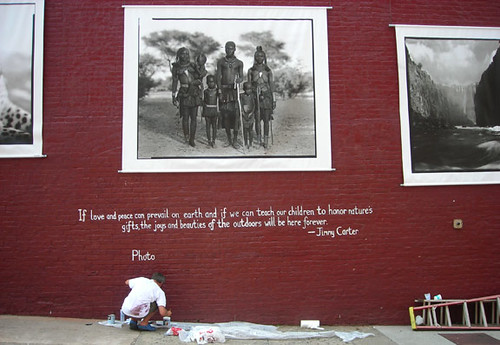 (fotonorth)
(cmak)
Wednesday, June 27, 2007


Tuesday, June 19, 2007
Friday, June 15, 2007
You wish you worked for this guy

Bobbin has a fascinating discussion with Dr. Robert Sutton, author of the New York Times bestseller "The No Asshole Rule: Building a Civilized Workplace and Surviving One That Isn't". Bobbin and Robert discuss the genesis of the book, how to deal with, erm, difficult people and clients, why audacious book titles need to also be accompanied with great content, the most asshole-ish thing he's ever done—and more.
Fortunately, all of my clients are fabulous.
No A**holes here.
Rewarding

It's nice to get an award, especially when you didn't know the work had been submitted. The Darden BusinessCast has received a Gold Hermes in the Podcast category!
Congrats to Ken and the rest of the crew I've worked with on this show over the last year. If you want some behind the scenes info on the show, don't miss the Case Study we did on it a few months ago.
Thursday, June 14, 2007
Experienced (have you ever been?)

It's a must-hear. Here.
I've seen Jim's presentation, and it's fantastic. There's something for everyone in this show.
Wednesday, May 23, 2007
Does your voice need more than... a voice?

My morning RSS reads took me to the (relatively) new Odiogo Voice App (thanks to The Official Lair of Daniela). Odigo claims:
Turn readers into listeners, and transform your blog into a high quality, ad-supporting broadcast that can vastly expand your audience reach!
- Automatic podcast generation
- “Near-human” quality text-to-speech
- Drag-and-drop integration on your blog
- Detailed download statistics
- Make money from embedded ads
- Leverages RSS feeds of all blogging platforms such as Typepad and Blogger
Love the "Near-human" voice. Love the automagic nature of converting text to voice. Love that I can listen to your blog while I'm cruising the highway. Well, at least I love the idea.
What strikes me almost immediately is the subtle, yet severe difference in writing for voice vs. print. The Odiogo reader sounds good - don't get me wrong - it just doesn't sound quite right. I can tell in the first sentence or two that, while this is being read well, it was written to be read - but not read to the reader or audience.
Take the example of how even the best book requires the intermediate step of going to a screenplay before it can be produced for film. It's not because it has to be trimmed down to 100 pages - it's because people just don't talk that way (notice I didn't say speak that way - Odiogo speaks fairly well). The auteur is generally a master of her medium, and understands that when you have a book (or a blog) in hand, the audience will bend their mind to that way of "listening". When you're really listening (with your earholes), you expect it to be natural, to be involving, perhaps to be conversational - all things one can pull off in print just as well, but have to be pulled off... differently.
Some of the best print writers I've known have had trouble making the jump to broadcast (and now, podcasting) for this very reason. It's not for lack of great ideas and strong creativity, but working under the assumption that the delivery (one's voice) isn't nearly as important as the package being delivered.
The good news for writers is that the fix is easy: practice, practice, practice. Unfortunately, a robot can't get you there (yet), but if you're trying and it's not working, you'll be able to hear it.
There's a lot more to be said about Voice, but in the voice of a blog, my gut tells me that I should keep it short.
Subscribe to:
Posts (Atom)
